

Blogs
📋 Table of Contents
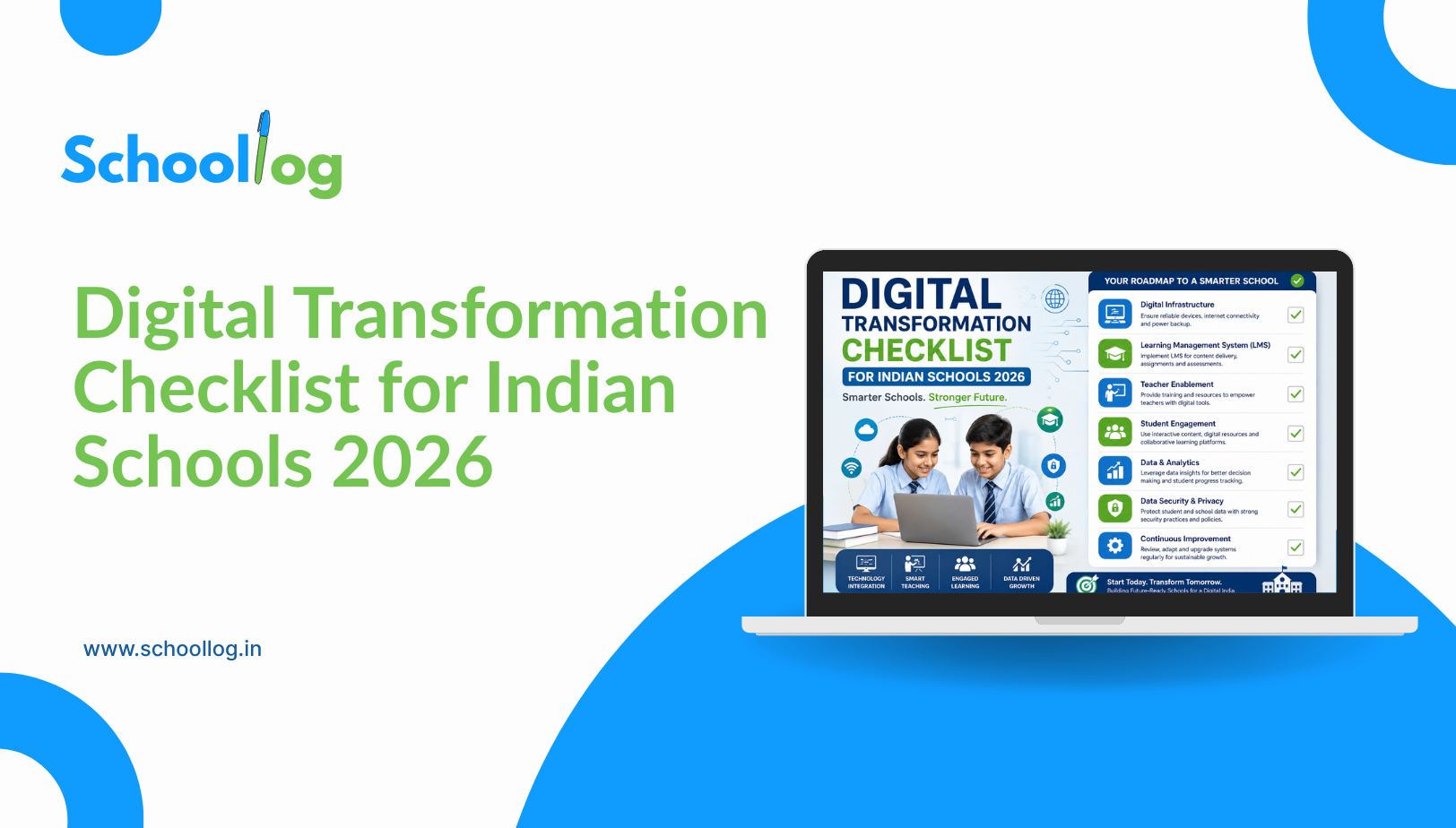
Digital Transformation Checklist for Indian Schools 2026
08 Aug, 2026
In 2026, Indian Schools would mean schools with processes already in a digitally converted and streamlined manner that cover every step from administration and teaching to learning, communication to collaboration, and evidence-based decision-making. From admissions to attendance, payments to process, exams to transport, or from student support to parent communication, schools have tremendous amounts of data moving between departments in the course of their day-to-day activities. Without an all-in-one digital solution, manual register management and complex Excel sheets result in manual errors, which ultimately increase the chances of an issue.
Using a well-designed digital transformation checklist for Indian schools enables school administrators to quickly assess where gaps exist as well as make better-informed investment decisions and ultimately the construction of an integrated system and effective school environment.
What is Digital Transformation in Schools?
Digital transformation for schools (education) means redesigning education, processes, and systems by leveraging technology in its core activities of teaching, administration, and operations. It is far from replacing paper-based record-keeping with electronic document storage. Any school in India could begin transformation by starting with an integrated school ERP system, which might include:
-
School ERP centralizing students, teachers, and their activities
-
Tracking online attendance
-
Facility for online school fee payments, etc.
The intent is to simplify the school management software & enhance the learning experience for teachers, learners, parents, and school administration.
Digital Transformation Checklist for Indian Schools in 2026
1. Develop Measurable and Specific Technology
Define what school digital transformation will help the school achieve before buying it.
-
Do the school’s administrators spend valuable time on their monthly duties that might very easily be done automatically?
-
Are school leaders not able to collect and access important data quickly enough?
-
Can teachers not find parents' updates easily?
-
Are school leaders' data unavailable when they need to know?
The administration develops specific technology goals, such as automating part of the paperwork workflow and improving the accuracy of attendance tracking. Accelerate payment collection; enhance parent and community relations.
2. Review Existing School Systems
Examine your school’s existing procedures and note which ones are still manual or scattered.
Check out:
-
Admissions & Student Information Registration
-
Attendance management of attendance records
-
Fee payment & collection of dues
-
Exam and report card issue
-
Timetable making
-
Transport System management
-
HR & salary calculation & payroll system
-
Communication with parent & teacher
-
Document management
From this review, the schools get an overview of the departments and will get their preferred sections digitized on top of it.
3. Adopt a Centralized School ERP
A centralized School ERP system can integrate key functions across a school into a single, centralized platform. A good option would cover admission management systems, student management, attendance, fees management, examination, communication and transportation, HR & accounting, reports, and analytics of school operations. This eliminates the issue of duplicate work and makes day-to-day work easy.
4. Digitise the student records, attendance & Fee records
Schools can shift from manual records management. Automatic receipt generation for the fees to be paid, reminders for pending payments, biometric/facial recognition for student attendance, and also face detection and central profiles of students will help streamline the process of school management.
5. Enhance Digital Communication & Digital Learning
A digitally-enabled school will empower schools to ensure easy access for their parents. From reading school circulars and checking daily attendance, assignments given to the students, and also the exam schedule, to paying fees online, parents could keep track of these through an integrated application. Active engagement could also make the students realize the app features on their own via tasks like online tests, performance metrics, etc.
6. Leverage Data, Analytics and AI Intelligently
Attendance, student report grades, admissions, and the amount of school fees captured, as well as progress monitoring, are monitored by school administrators through dashboards and automatic reports. Other programs will thoughtfully implement AI for routine administration, for teaching and learners in the school environment in 2026, and for school and staff review.
7. Improve cybersecurity & Data privacy
The school will store increasingly sensitive personal data of students and employees; therefore, it is crucial to consider adequate protection of this data by adopting necessary security measures. It includes appropriate access control, strong passwords, a backup facility, data encryption and updating software, and using MDM for schools to centrally manage devices, enforce security policies, and safeguard sensitive data across the school’s device ecosystem.
8. Streamline School Transportation and Operations
Digital education solutions for school transport operations include: Using a GPS to monitor school buses, manage routes, geofencing buses, taking attendance, and receiving and sending real-time notices to parents for operations; using a digital format of documents, HR, and payroll can all form a coherent integrated network of management of operations.
9. System Integration & Training Staff
Digital tools must be well-connected so as not to isolate staff again. Schools should ensure that their ERP, Learning Management System, HRMS, biometric machine, payroll, accounting software, and payment gateway systems are integrated to ensure these various functions and services run from an interconnected system. Also, keep adequate and regular information and training updates for teachers and administrative staff, together with technological support and appropriate management.
10. Review progress and measure results
Digital transformations in education have a tendency to fail due to their lack of assessment. Schools must develop metrics for reporting on areas such as administrative time savings, reduction in paperwork, attendance accuracy and collection rates, fee revenues, reduced costs, and user experience. Frequent assessments would identify opportunities for the schools to embrace future innovation.
How Schoollog Supports Digital Transformation
Schoollog enables schools to unify several administrative and academic activities under a single connected system. In an all-in-one platform, schools can get support for school fees, attendance, school admissions, reports, student database, examination, student transport, messaging services, and student information system.
Schoollog can aid schools in reducing their reliance on fragmented toolkits and manual work and thus foster a more efficient and data-driven method to manage the school effectively and smartly.
FAQ
-
What is digital transformation in schools?
Digital transformation in schools, also referred to as digital innovation or transformation processes, refers to the technological processes to drive enhancements in school education, administration, operations, or communications by digitally networked structures.
-
Why is a digital makeover of Indian schools by 2026 necessary?
It can assist schools in doing away with manual work, increasing efficiency, managing their affairs effectively, simplifying communication, storing and systematically categorizing information, and helping the administration take faster and better decisions based on data.
-
How does a school ERP facilitate digital transformation?
The ERP provides a comprehensive platform that helps in bringing schools' various functions together while preventing duplicate entry of information, automating most repetitive functions, and centralizing data for better access and visibility.
-
Does school digital transformation require AI?
It is not essential, but schools can investigate appropriate, accessible AI uses that help them function more efficiently with administrative, personal learning, analytical, and educational tasks.
Conclusion
Digital school transformation for Indian schools in 2026 must move into a higher gear as schools streamline day-to-day operations, centralize data management, and utilize new technologies. By establishing centralized school ERP software and taking steps to automate and leverage technology, schools could improve the experience for teachers, students, and parents together.
✍️ Muskan Singh
Hi, I'm Muskan Singh, a content writer passionate about exploring how technology, EdTech, and SaaS are shaping the...
Show More📞 Get In Touch
Have questions? We'd love to hear from you!
✍️ Muskan Singh
Hi, I'm Muskan Singh, a content writer passionate about exploring how technology, EdTech, and SaaS are shaping the...
Show More📞 Get In Touch
Have questions? We'd love to hear from you!
Related Blogs

5 Myths About School ERP Debunked: What You Really Need to Know
As we know, there is advanced time and most of the schools and colleges are adopting the School Management Software system to make their work easier. But still, people still have wrong notions about the School ERP Systems. Below, we dispel five myths and focus on five things you should understand.

How School ERP Software Saves Time and Money for Educational Institutions
Ever feel like your school is drowning in paperwork and administrative tasks? You're not alone. Managing a modern educational institution can be a real headache, eating up precious time and resources.

A Comprehensive Guide to School ERP: Boosting Efficiency and Communication
Ever feel like your school's drowning in paperwork and miscommunication? You're not alone. That's where School ERP systems come in, swooping in like a digital superhero to save the day. These ERP tools are revolutionizing how schools manage everything from admissions to report cards.