

Blogs
📋 Table of Contents
How to calculate the ROI of School ERP Software
06 Jul, 2026
With schools increasingly embracing digital technologies for school administration, education management, and management of teaching in classrooms to improve the learning experiences and process, and to administer to students and parents with efficient communication. School ERP software has become the must-have technology for schools across the globe. In the school administration system, the ROI of School ERP software is a major topic of discussion, and many of our clients ask: What exactly do I get when I invest in ERP software for my school?
By computing the Return on Investment for School ERP software, schools are able to analyze if the purchase of such software is providing them with actual and visible economic and functional returns. ERP software, as one of the major costs of a school institution, is indeed one where it does need an immediate capital; however, the time and manpower savings can be beneficial and worth more than its expenses in the long term.
Let us now guide you on how you can determine the Return on Investment of School ERP software and highlight the advantages that would eventually contribute to long-term value.
What does ROI stand for in School ERP software?
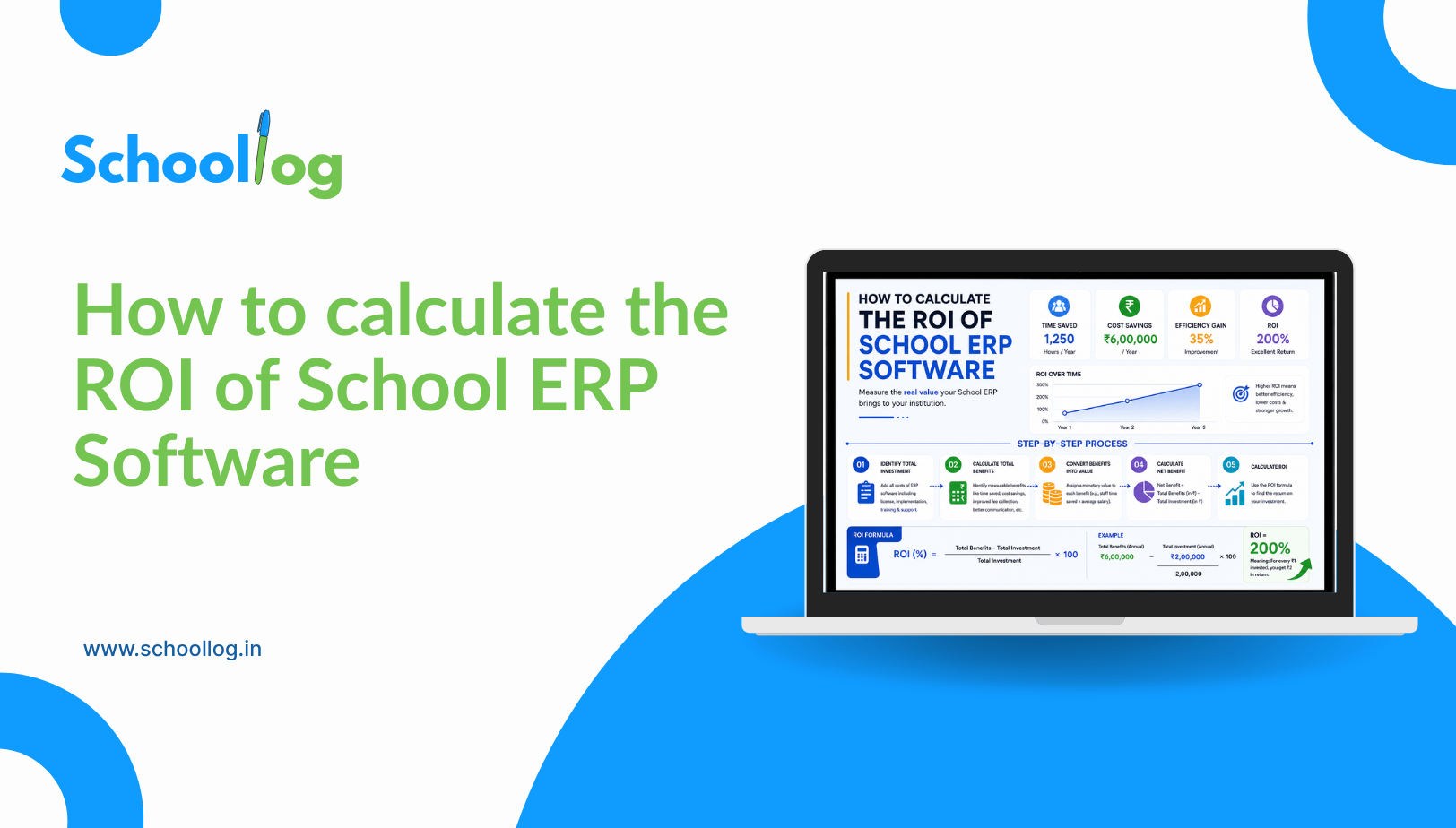
ROI, meaning return on investment in the School ERP software, quantifies the benefits of ERP in the form of finance and operations when compared to the cost of ERP software. Formula ROI (%)=[ (Total Benefits- Total Investment Cost) / Total Investment Cost] x 100. A positive ROI suggests the investment was worthwhile, and therefore, ERP software deployment is the correct decision to make.
What is ROI & Why Measure it for Schools?
Most schools will look at the software cost of purchasing a school ERP system and not take into account the added cost of manual administrative tasks. The following will help school institutions to:
-
Defend the acquisition of the software system
-
Monitor changes within schools, identify and cut out waste in operational costs
-
Identify and eliminate administrative costs
-
Increase the operational effectiveness of school employees
-
Automate the fee collection process
-
Use data for budgeting and future decisions
Instead of thinking of ERP software as an expense, schools can perceive it as a long-term strategic investment.
Step 1: Determine Total Cost of Investment
The first phase consists of identifying the entire price involved in setting up and installing ERP for schools, which may include:
-
Software subscriptions or licensing software
-
System configuration or installation
-
Data migrations
-
Training
-
Staff training
-
Ongoing software support
-
Customizations & other costs
Knowing the complete investment ensures an accurate ROI calculation
Step 2: Calculate Savings on Administration
The benefits of the School ERP software are immense, as it helps save time & effort on repetitive manual tasks. This manual work, which takes so many hours from your administration team each day, consists of: daily attendance monitoring, admission processes, preparing students' report cards, updating student details, fee collection & reminders, examination schedules, etc.
Example: Let’s assume an administration group saves an average of 4 hours per day, and the average employee expense is 300/hr: 4 hours/day x 300 hour x 250 working days/ year= 3,00,000 saved per year. With employee savings alone, the ERP recovered its annual investment.
Step 3: Track Enhanced Fee Collection
Payments for outstanding fees may cause a cash flow problem for a school, and the administrative staff needs to continuously track them. With a school ERP system, fee payments management becomes much easier as they provide for the following features:
-
Online fee payment
-
Online fee reminders
-
Digital receipts
-
Live payment tracking
-
Multiple payment gateways
Hence, your school can witness: Better on-time payment collections, low pending amounts, and outstanding amounts reduced to a much lower number, good financial management for schools, e.g., if there’s a reduction in outstanding fees by 9 lakh, then that directly contributes to a better ROI.
Step 4: Calculate the Savings on Productivity
An ROI can be based not only on decreasing expenses, but also on growing the efficiency of your operations. A School ERP benefit reduces the time your educators and administrative staff devote to administrative tasks and allows them to focus on core teaching and learning operations. With an ERP, you can streamline many administrative functions, including an attendance management system, timetabling, examination planning and scheduling, students’ grade reporting and monitoring, communicating with parents, and generating all necessary reports.
Step 5: Factors in Intangible Gains
The most beneficial gains in School ERP software may not be calculable in purely tangible money but could impact the institution for a long time. They are:
-
Greater Parent Involvement:
The Parents can now view their child's fee status, homework, attendance, result update & much more on the move on our student-specific mobile app that brings more transparency and builds confidence.
-
Swift Decision Making:
School administrators and the management team are empowered with live dashboards and analytical reports of attendance, admissions, fees collection, academic progress etc. That help them make intelligent decisions.
-
Better Student Experience:
Students receive quick updates from anywhere and everywhere, receive their digital content with a click, obtain the updated exam & assessment schedule, and have smooth communication with the teachers.
-
Better Brand Image:
A tech-savvy school tends to look more impressive in the eyes of the current generation’s parents who are looking for efficiency and digitalization. These intangible advantages can largely enhance the enrollment numbers.
How does your school benefit from Schoollog’s School ERP?
Schoollog is a complete, cloud-based School ERP that streamlines operations such as admissions, attendance management, fee management, examination management, transport management, communications, and reports. Automating administrative tasks & enhancing operational effectiveness with our School administration software that can save valuable time & cost for schools, increasing parent interaction & ROI for educational institutes.
Conclusion
Determining ROI for school management software allows the school to measure the real benefit of its investment in technology. However, in addition to saving on school costs, the software streamlines business, cuts down on the administration workload, enhances the school’s communication, and assists it with decision-making. A well-implemented school ERP system from Schoollog makes it easier for the school to run and operate its institution more effectively for sustained and lasting success.
FAQ
-
How is the ROI of School ERP software determined?
ROI refers to the benefit derived from a school management solution with regard to its value in terms of cost and investment.
-
How do we compute ROI for School ERP?
Employ the following equation: ROI(%)=[ (Total benefits- Total Investment Cost)/ Total Investment cost]x 100.
-
What ROI benefits can we expect from School ERP?
Factors like cost savings, increased fee collection, minimal paperwork, employee efficiency, time savings, and better communication with parents should be part of School ERP ROI.
-
When will we see the ROI of our School ERP?
Many schools see visible changes within a couple of months and fully recover their investment in the first year of their School ERP installation.
-
How does SchoolLog improve the School ERP’s ROI?
Schoollog can simplify many of the areas of managing your school and automate many of the boring and time-consuming tasks, resulting in less manpower, less money, and less wasted time.
✍️ Muskan Singh
Hi, I'm Muskan Singh, a content writer passionate about exploring how technology, EdTech, and SaaS are shaping the...
Show More📞 Get In Touch
Have questions? We'd love to hear from you!
✍️ Muskan Singh
Hi, I'm Muskan Singh, a content writer passionate about exploring how technology, EdTech, and SaaS are shaping the...
Show More📞 Get In Touch
Have questions? We'd love to hear from you!
Related Blogs

5 Myths About School ERP Debunked: What You Really Need to Know
As we know, there is advanced time and most of the schools and colleges are adopting the School Management Software system to make their work easier. But still, people still have wrong notions about the School ERP Systems. Below, we dispel five myths and focus on five things you should understand.

How School ERP Software Saves Time and Money for Educational Institutions
Ever feel like your school is drowning in paperwork and administrative tasks? You're not alone. Managing a modern educational institution can be a real headache, eating up precious time and resources.

A Comprehensive Guide to School ERP: Boosting Efficiency and Communication
Ever feel like your school's drowning in paperwork and miscommunication? You're not alone. That's where School ERP systems come in, swooping in like a digital superhero to save the day. These ERP tools are revolutionizing how schools manage everything from admissions to report cards.