

Blogs
📋 Table of Contents
RFID Card: Complete Guide to Smart Identification Solutions
24 Aug, 2026
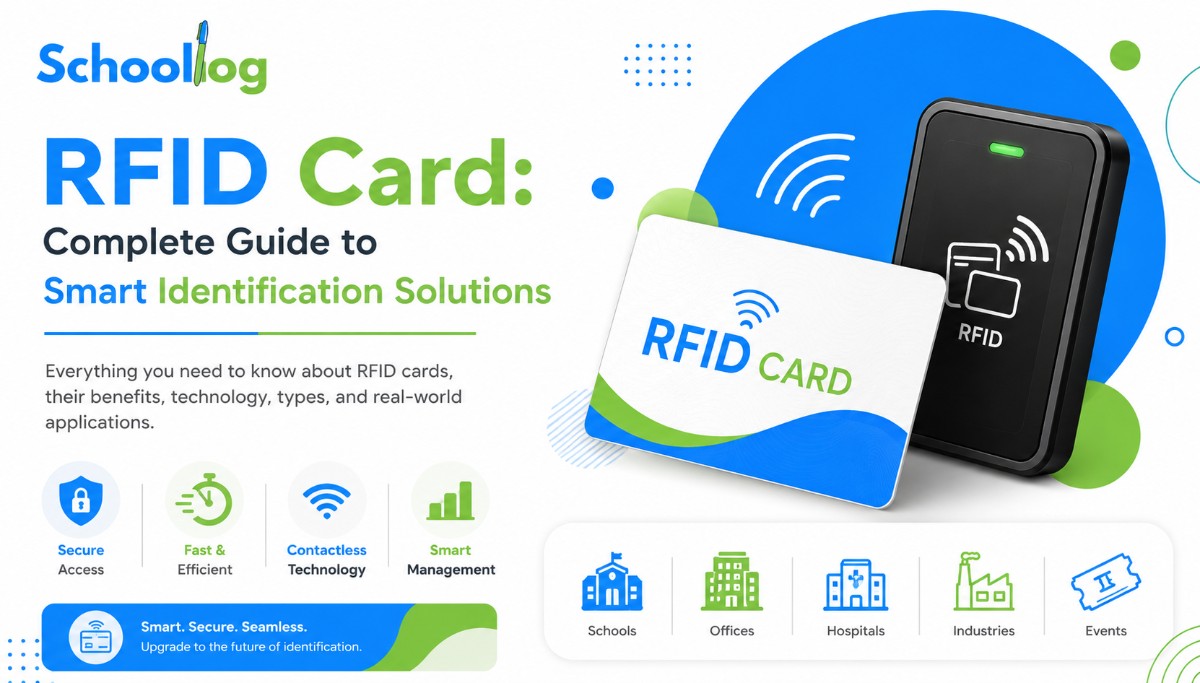
RFID cards are changing the way schools provide identification to students, record attendance, access, and general management on campus. Different from a normal ID card, the RFID card makes use of radio frequency to communicate and transfer its data to any reader with a compatible radio frequency, and enables the school to remove much manual work, starting with identification. When embedded with a School ERP system, an RFID card is able to integrate student identification together with the attendance management system, parent communication, access management, transport, etc.
What is an RFID card?
RFID means Radio Frequency Identification. An RFID essentially consists of a chip and an antenna that allow the identification of the card without wires from any card reader with compatible features. Each RFID card also stores a number ID unique to the student to associate and correlate with the student’s record available in the school management software database.
RFID cards in schools can be applied to:
-
Student attendance
-
Teacher attendance
-
Entry/Exit system
-
Access control system
-
Library management
-
School bus attendance
-
Student identification
-
Events
How Does an RFID Card Work?
There are basically three elements used in an RFID system: RFID card, RFID reader, and software. The process flow is typically: RFID card-RFID reader- Software/ERP Record or action.
For instance, on school entry, the RFID card reader senses the student's card and collects the unique ID. The unique ID is then compared with the student's profile, and attendance time is noted.
If interfaced with School ERP, this data can be passed to update attendance and further send a notification to the parent.
The precise procedure would vary according to what RFID systems/ reader are used. Some systems require the students to place the card nearer to the reader, whereas long-range systems can detect cards up to a certain distance.
Types of RFID Cards
1. LF RFID Cards
Low-frequency RFID cards operate in frequencies typically 125- 134 kHz and are for short-range identification. They work well for applications like secure entry points where the card is placed near a reader.
2. HF RFID Cards
High-frequency cards use RFID technology with frequencies of 13.56 MHz, as a typical product that has various uses like identification, access, libraries, etc.
3. UHF RFID Cards
Ultra-High Frequency RFID means cards can be read from much further away, and could be suitable for school gates or identification from vehicles. When using appropriate hardware in your environment, several cards can be identified without having to stop and scan them.
RFID Cards vs Traditional ID Cards
The standard Student ID card is generally for identification only. The required information on it includes the student’s name, photo, class, roll number, and school name. The RFID card will be able to perform identification at both the physical level, with the student’s data printed on the card, and with digital information stored within it.
|
Feature |
Traditional ID Card |
RFID Card |
|
Student Identification |
Yes |
Yes |
|
Digital Identification |
No |
Yes |
|
Automated attendance |
No |
Yes, with compatible readers |
|
Contactless Identification |
No |
Yes |
|
Access Control |
Limited |
Yes |
|
School ERP integration |
No |
Possible |
|
Student movement tracking |
Manual |
Automated with suitable setup |
Given this, RFID cards are particularly suited for schools moving past simple identification toward campus integration.
Benefits of RFID Cards for Schools
-
Increased Speed of Attendance
Attendance can be taken manually during a limited classroom time. Using RFID, it can be automated, and the repetitive entries can be reduced to zero.
-
Increased Precision
RFID can also minimize human error because of its potential to get to the right database for error-less entry and failure in tracking attendance. Nonetheless, schools should recognize that RFID tags the card, not the wearer; security must be addressed for the prevention of sharing.
-
Enhancement of Security on Campus
RFID card can be interfaced with an access control system to authorize entry into rooms such as lecture rooms, labs, libraries, office rooms, hostels, and all other restricted areas on the campus.
-
Notifications for Parents
If RFID attendance system is integrated with School ERP and communication system, the school is able to timely provide notification to parents for the arrival and departure of students.
-
Centralized Data Processing
It will be easy to integrate the RFID-generated data with the central profile of students into ERP rather than maintaining separate records for attendance and ID.
Where Can Schools Use RFID Cards?
-
Student Attendance
RFID cards can also log when a student has arrived and when they have left, allowing schools to manage their student’s attendance automatically.
-
School Bus Tracking
In school buses, RFID readers can read the cards as the students board and when they exit. This data may then be used for tracking and communication.
-
Management of Library Resources
RFID would help with easy identification of students and their access to the library and reduce data entry work on records.
-
Access to Restricted Premises
Schools may use RFID cards to regulate and have authorized access to restricted areas depending on school students' and staff authority.
-
School Activities/ Events
RFID cards could also aid in student identification in examinations, competitions, functions, etc.
What Should Schools Consider Before Implementing RFID?
Before implementing an RFID solution, schools must check:
-
Reading range- short read or long read ID
-
Number of students- large schools may need many readers and entry doors
-
ERP integration- RFID can integrate with School ERP
-
Student card durability- it should withstand long use by students
-
Data security- access controls must protect students’ data
-
Lost card procedure- it should be a swift procedure to block lost cards
-
Offline capability- check working during temporary internet failure
-
Scalability- consider if the solution can handle future needs
RFID Cards vs Biometric Attendance
RFID and biometrics both offer automatic identification but in their unique manner.
|
Factor |
RFID Card |
Biometric |
|
Identification |
Card |
Face/ Fingerprint |
|
Physical card |
Required |
Not required |
|
Contactless |
Usually |
Face: Yes |
|
Card sharing risk |
Possible |
Lower |
|
Replacement |
Required if lost |
Usually unnecessary |
|
ERP integration |
Possible |
Possible |
The correct answer will depend upon the school’s security requirements, budget, age of students, infrastructure, and facility operations.
Best Practices for RFID implementation
Schools can improve RFID deployment as:
-
Every card is assigned a unique ID
-
All cards are associated with the correct student information
-
A lost card replacement policy is developed
-
Readers are placed in convenient locations and not readily accessible to individuals without RFID cards or administration to control the flow of students.
-
The attendance and access information is kept safe and securely protected
-
Staff are trained in basic troubleshooting for RFID issues
-
Back-up procedures are in place
-
Attendance and access reports are constantly evaluated
FAQ
-
What’s an RFID card used for?
RFID card offers wireless identity and is used for such school purposes as tracking attendance, managing RFID access control, controlling library functions, or monitoring buses for children.
-
Can school attendance be tracked through RFID cards?
Yes, an RFID card used with appropriate readers and school attendance software helps the school management system to streamline the attendance process in an automated and effective manner.
-
Can school attendance RFID be integrated with a School ERP?
Yes, by installing proper RFID hardware and software required for such an implementation, the data can be integrated into a central school ERP for managing the entire student attendance record along with the student details.
-
What about a lost RFID card?
The missing RFID card needs to be deactivated by the agency or facility and replaced with a card with the same unique identification number.
-
Are RFID cards safe/secure?
RFID technology in schools is safe/secure to identify cardholders, but in general, RFID security relies on the RFID technology, hardware, software, access controls, and implementation.
Conclusion
RFID cards provide an easy route for schools to automate modern card solutions for identification, attendance tracking, access control, and various other everyday tasks. Connected with an ERP like Schoollog ERP, the technology makes it possible to combine automatic identification with student data and communication with parents.
For schools in the process of digitalizing their campus, implementing RFID technology is a smart approach.
✍️ Muskan Singh
Hi, I'm Muskan Singh, a content writer passionate about exploring how technology, EdTech, and SaaS are shaping the...
Show More📞 Get In Touch
Have questions? We'd love to hear from you!
✍️ Muskan Singh
Hi, I'm Muskan Singh, a content writer passionate about exploring how technology, EdTech, and SaaS are shaping the...
Show More📞 Get In Touch
Have questions? We'd love to hear from you!
Related Blogs
Biometric Attendance System for Schools in India
Implement a biometric attendance system for schools to streamline attendance tracking, enhance security, and increase student safety with Schoollog's expert solution
How a Biometric Attendance System Works: Complete Guide for Schools
A complete guide to biometric attendance systems in schools. Learn how they save time, prevent proxy attendance, improve security, and support smart school management.