

Blogs
📋 Table of Contents
School ERP vs Google Workspace for Education: Which Solution Does Your School Really Need?
20 Aug, 2026
Most of the schools these days depend on technology for everything and anything, ranging from classroom learning; the way to communicate with parents of the student; taking student attendance; managing student fee collection; conducting student exams and storing student details, etc; to implement such things, school administration compares the types of software that the school needs to purchase.
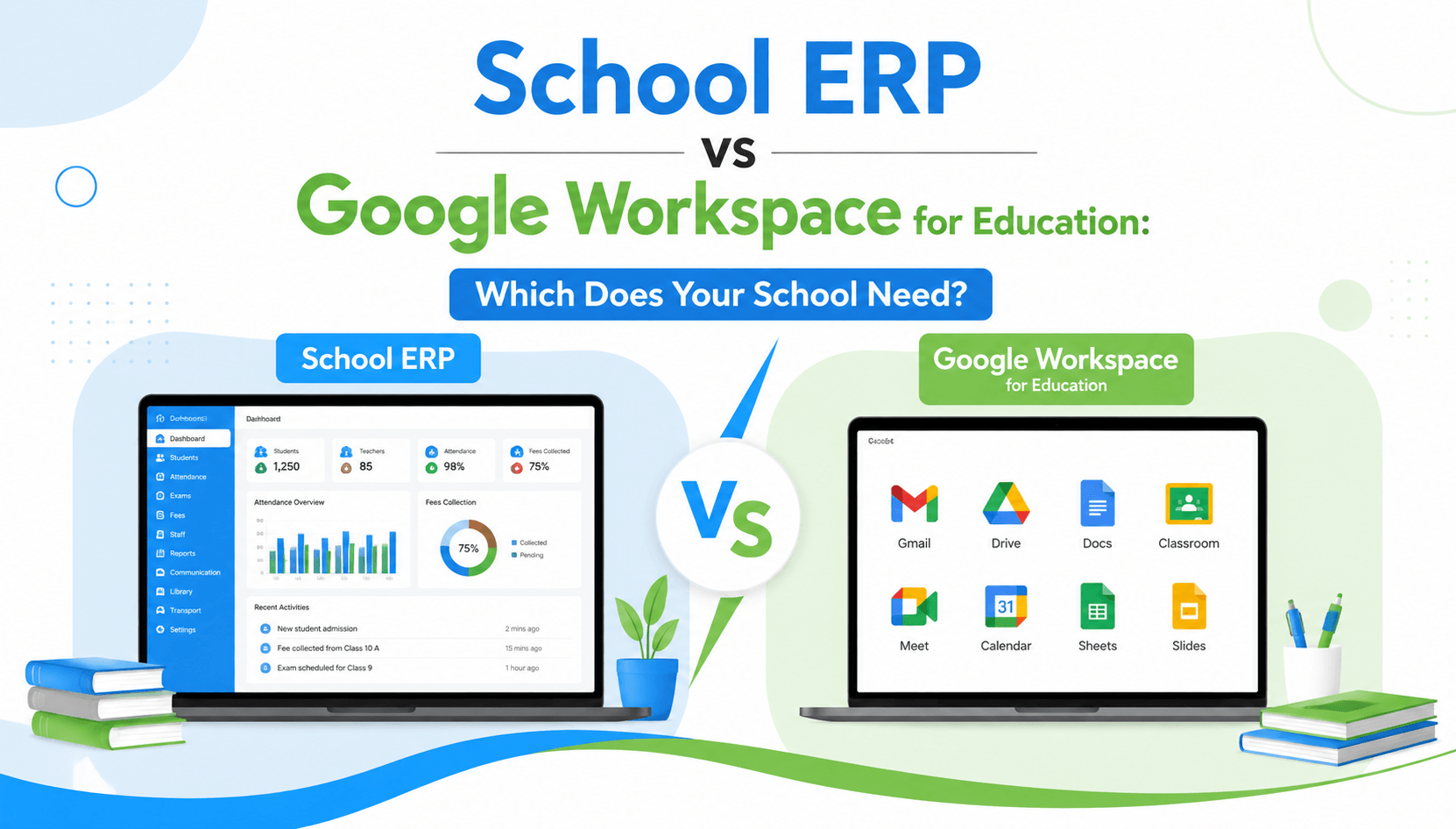
Let’s discuss two solutions currently being explored: Google Workspace for Education and School ERP solutions. On the surface, these solutions seem similar since they both employ tools that make a school’s day-to-day activities easier and more productive. Yet, the purpose of each solution could not be more different: Google Workspace for Education is for communication, collaboration, productivity, and digitally inspired learning, and the other is for managing students and school activities.
Recognizing the distinction will allow school leaders to make the most appropriate technology investments.
What is Google Workspace for Education?
Google Workspace for Education is the collection of cloud-based apps- Google, Gmail, Google Drive, Google Docs, Sheets, Forms, presentations, and products designed to support teachers in managing assignments, lessons, and communication, and to support students in engaging collaboratively.
By utilizing these apps, a teacher could:
-
Conduct online classes
-
Share educational materials
-
Distribute work
-
Work with others on papers
-
Send emails
-
Store documents
-
Gather data via forms
-
Schedule meetings and events
These features streamline digital learning and co-operation for both students and teachers. But productivity tools still fail to address the needs of running a school: there are a multitude of operations, such as managing admissions, student information, fee management system, attendance, exams, transportation, staff data, and school reports.
What is a School ERP Software?
A School ERP Software or school management software is specifically designed for education organizations. Such ERP solutions link different school divisions and procedures via a single platform or online presence. Schools typically rely on many spreadsheets and programs; with ERP for school management, they may centralize each of the day-to-day operations of their schools.
A school ERP can have modules for the following, depending on the platform:
-
Online admissions
-
Attendance
-
Fee management
-
Examinations and report cards
-
Homework and assignments
-
Time-table management
-
Teacher & staff management
-
Parents communication
-
Transportation
-
Library management
-
Notices
-
Reports & analytics
It is envisaged to create one database containing all the information on the academic and administrative functioning of the school.
School ERP vs. Google Workspace for Education: What’s the difference?
The simplest explanation of how they differ is to understand what the systems aim to achieve. Google Workspace for Education is centered around productivity and collaboration.
The underlying function of any ERP for schools is largely to function as an ecosystem for the operation and administration of a school. For instance, a teacher can assign an assignment via use of Google Classroom, but it is typically the School ERP system that would keep track of students, along with attendance, fee balance, marksheet, and communication log.
Likewise, one may keep the record for collection of fees on a Google spreadsheet, but a specific school fees management system will automate fee structures, collection status, generate receipts, and track all dues for a student. As a school grows, it makes the disparity clearer.
Reasons Why Schools Need to Look Beyond Google Workplace
Schools might have everything they need to enable good online AI productivity tools like documents, online meeting software, calendars, online classrooms, and emails with Google Workspace.
Data can be Fragmented:
When different files and apps are created on multiple spreadsheets, it can lead to a lot of information being distributed all over the place. When this happens, it can be difficult for the admin to see all aspects related to the students clearly.
Manual Data Maintenance:
A school worksheet may track who comes, but someone still has to maintain the record, check it, categorize it,t and use it to prepare student reports and other reports. A good school software can handle some of these mundane tasks automatically.
Lack of School-Specific Workflows
Every school follows a distinct protocol when it comes to admissions, fee management, examination operations, student attendance, transportation, and admissions management. Standard productivity tools may have no ready-made workflow solutions in order to manage these tasks.
Reporting issues
School managers are often asked for unified information regarding enrollment, attendance management system, fee collection, academics, etc., and operational statistics in one place. A good ERP system for schools can fulfill these needs by having dashboards and reports readily available.
Key Benefits of a School ERP System
1. Integrated School Management:
There is a platform for the school’s entire operations;i.e school ERP. It means the administrator doesn’t need to switch over many systems like spreadsheets, forms, communication, database, etc.
2. Centralized Student Information:
Student records can be kept on a central system. This process enables simplification in database organization by doing away with the multiplication of records and thus reducing duplication.
3. Automated Attendance Management:
The attendance registers/reports can be maintained digitally by teachers to save on administrative work as well. Parents would be getting the relevant updates regarding attendance through an included communication facility.
4. Effective Fee Management:
A school ERP facilitates fee collection and reporting through payment history, dues reminders, receipts, and reports, and would make it ease out process easier for accountants, parents, and management of a school.
5. Better Parent Communication:
A fully featured school management software ensures notices, updates on attendance, notifications of assignments and fees, etc will be sent from one system. This streamlines communication to parents and vice versa.
6. Data- Informed Decision-making:
The ability to gather information from school and to identify and evaluate trends and use it for decision -making based on contemporary facts can help with strategic planning for admissions, attendance, academics, finance, and other school operations.
Conclusion
Every school has specific requirements in terms of digital management. While Google Workspace can enhance school collaboration, communication, and digitally support the learning aspect of a school, the presence of a School ERP system consolidates all necessary school activities into a single platform. If your school is striving for faster and simpler administration for school functions, a school management system such as Schoollog may be able to help you create a strong and centralized online presence for your institution.
✍️ Muskan Singh
Hi, I'm Muskan Singh, a content writer passionate about exploring how technology, EdTech, and SaaS are shaping the...
Show More📞 Get In Touch
Have questions? We'd love to hear from you!
✍️ Muskan Singh
Hi, I'm Muskan Singh, a content writer passionate about exploring how technology, EdTech, and SaaS are shaping the...
Show More📞 Get In Touch
Have questions? We'd love to hear from you!
Related Blogs

5 Myths About School ERP Debunked: What You Really Need to Know
As we know, there is advanced time and most of the schools and colleges are adopting the School Management Software system to make their work easier. But still, people still have wrong notions about the School ERP Systems. Below, we dispel five myths and focus on five things you should understand.

How School ERP Software Saves Time and Money for Educational Institutions
Ever feel like your school is drowning in paperwork and administrative tasks? You're not alone. Managing a modern educational institution can be a real headache, eating up precious time and resources.

A Comprehensive Guide to School ERP: Boosting Efficiency and Communication
Ever feel like your school's drowning in paperwork and miscommunication? You're not alone. That's where School ERP systems come in, swooping in like a digital superhero to save the day. These ERP tools are revolutionizing how schools manage everything from admissions to report cards.