

Blogs
📋 Table of Contents
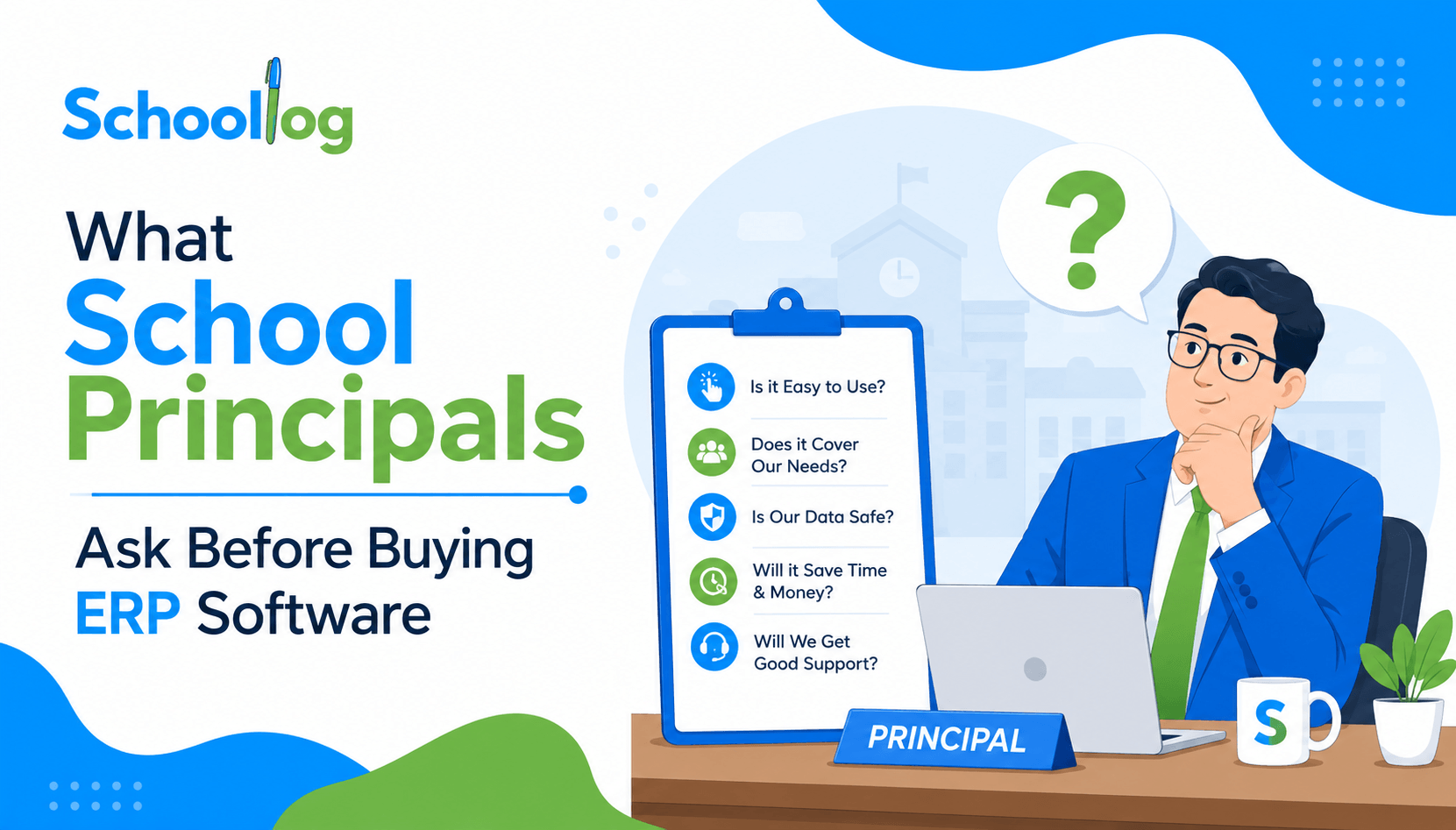
What School Principals Ask Before Buying ERP Software
10 Aug, 2026
When a school chooses to implement a school ERP system, the discussion often begins and ends with the features. But for a school principal, selecting an ERP isn’t simply about making attendance tracking paperless or offering an online payment portal. It means choosing a platform that can help drive a strategy academically, is efficient operationally, supports teachers, and is enjoyable for the students and parents.
The school ERP software becomes entrenched in the workflow of the institution for years. It can affect how well admissions are processed, how the teachers track students’ grades, how parents are kept informed, and how effectively principals make decisions based on live data. Perhaps this is why wise principals never ask, What is the cheapest ERP solution?” But rather, ask questions that will help them determine if this is indeed the perfect fit.
Consider these factors before you start comparing to select the right school ERP for schools.
Will this ERP fix the daily issues in our school?
The very first question a principal should ask isn’t technology-related; it is school-operation-related.
Each institution has its own problem. Some institutions face challenges in handling physical attendance; some may invest many hours to create a fee report and parent follow-up in a traditional method, and the large ones might look at multi-campus attendance; however, some small-scale ones might seek solutions for better school admission and classroom management.
The right school ERP platform shouldn’t just introduce new technology; it should address current problems. The critical first step is understanding which challenges you wish to eliminate; an ERP system directly tackling these problems will result in clear improvements to efficiency and productivity.
Will teachers actually use it?
Technology can only create value when it is easily adopted by its users. Beyond that, teachers are already consumed by planning, grading, managing the classroom, guiding students, and more. An ERP system, whether the need is for multiple clicks per common task or the typical curve that teachers experience while learning a new system, can quickly find itself left unused and ignored.
Its simple, mobile, easy-to-access system may encourage or support use. Parents can monitor attendance, assignments, report card data, and fee payment, so they will not need to reach for your manual or seek out tech help. The easier the school management software is, the faster it will bring profit to your school.
Are we purchasing an end-to-end system or modules?
One of the biggest mistakes that schools make is that they believe all ERPs come with the same features.
Many providers will sell you what sounds like a complete solution, but then add extra charges for admission, examinations, transportation management, payroll, or communication software. Over a period, these extra costs build up to represent a greater overall outlay, forcing schools to try to integrate separate, disparate systems.
A genuine fully integrated school management ERP should bring together all departments, admissions, academics right the way through to finance and administration, allowing information to be streamed across the whole institution.
Can it boost parent Engagement?
This again reduces the physical distance between parents and the institution, thus creating a family relationship. Parents are more conscious about staying up to date on their child’s overall development and are concerned about their academic progression.
With effective ERP solutions, communication from the school to home becomes a lot easier. ERP not only delivers information but also manages it- notifications are sent, attendance is notified, and updates on homework, tests, fee reminders, report cards,s etc are issued via an interface the parents can easily access. This further helped minimize the distance between parents and the institute by encouraging a cordial parent-institute relationship.
Will our Data ever be secured?
Education institutions maintain critical, highly sensitive student and staff information-starting from their grading to finance; the data must be kept protected. Principals should investigate potential ERP providers on encryption methods, cloud data storage, backups, user permission protocols, and disaster recovery before they bring any systems into their institutions.
Understanding their approach earlier can save a lot of security concerns down the road.
In our modern institutions increasingly reliant on digital systems, data protection isn’t a requirement-it’s a necessity for school administration software.
Will this ERP scale with my school?
The needs of your school today can change drastically in the next five years. You might get more student applications, establish other campuses, or face newly introduced governmental mandates. Switching your business to a different school ERP system every few years sounds expensive and disruptive.
Selecting an application that can adapt will help your school expand and not outgrow its management system. Investing in futuristic technology is always a better long-term strategy than choosing an immediately comfortable solution.
Will it work with the systems we already use?
Most schools use a range of individual online solutions. We already provide these systems independently: biometric attendance trackers, GPS tracking systems for buses, payment processing, learning management system, and online communication platforms.
If you are installing an ERP, then ideally the system should sync to, rather than replace, the existing systems and avoid multiple data points and duplicate entries. It should enhance and connect your whole ecosystem of learning technologies for real, tangible efficiency in your school.
Does the value exceed the price?
Price is always one consideration; value is always far more. Instead of dwelling strictly on the price of a monthly subscription fee, principals need to weigh the overall benefit received. They will find that while a subscription may cost a little more, it can eliminate countless administrative hours, result in greatly increased fee collection, generate no paperwork, and contribute to efficiencies measured in hours every week.
Taking the entire total cost of ownership into account will help school administrators make good long-range decisions concerning their operational resources.
Is it possible to try the software before signing up?
The effectiveness and potential of any brochure or sales meeting simply cannot compare with actually trying the system itself.
Principals, teachers, and administrators can see first-hand, in real-time, exactly how the ERP will behave and function through a live demonstration or trial period. By testing the dashboards, reports, mobile app, workflow, and communication functions, stakeholders will gain insight into the ERP before signing a potentially long commitment. Engaging various stakeholders in the testing phase will likely lead to the most efficient implementation possible, with the users already accustomed to the ERP.
The perfect School ERP is not one with the most features-it’s the one that is perfect for your Organization.
Many ERP solutions come up short and offer way too many unnecessary options while the school doesn’t utilize those in many instances. Each school has varying objectives, procedures, and problems to solve, and the “ best school ERP software” does not boast of having the broadest possible capability and feature list or offering at the lowest price. What actually constitutes an excellent school ERP solution would be the solution that works harmoniously well together with the school’s mission and objectives.
Conclusion
A good selection of rthe ight questions during the decision process enables the principal to focus past the marketing jargon and identify a solution that is likely to reduce operational friction, enhance communication, boost the impact that teachers have on students, and raise student academic performance significantly. In Schoollog, a one-in-all cloud School ERP aims to reduce the administrative hassle for schools that are digitalizing their processes, including admissions, academics, attendance, fees, examination, communication, transportation, HR, etc. Our Education ERP software also features a user-friendly interface, scalability, and implementational assist to ensure schools concentrate more on providing quality education.
✍️ Muskan Singh
Hi, I'm Muskan Singh, a content writer passionate about exploring how technology, EdTech, and SaaS are shaping the...
Show More📞 Get In Touch
Have questions? We'd love to hear from you!
✍️ Muskan Singh
Hi, I'm Muskan Singh, a content writer passionate about exploring how technology, EdTech, and SaaS are shaping the...
Show More📞 Get In Touch
Have questions? We'd love to hear from you!
Related Blogs

5 Myths About School ERP Debunked: What You Really Need to Know
As we know, there is advanced time and most of the schools and colleges are adopting the School Management Software system to make their work easier. But still, people still have wrong notions about the School ERP Systems. Below, we dispel five myths and focus on five things you should understand.

How School ERP Software Saves Time and Money for Educational Institutions
Ever feel like your school is drowning in paperwork and administrative tasks? You're not alone. Managing a modern educational institution can be a real headache, eating up precious time and resources.

A Comprehensive Guide to School ERP: Boosting Efficiency and Communication
Ever feel like your school's drowning in paperwork and miscommunication? You're not alone. That's where School ERP systems come in, swooping in like a digital superhero to save the day. These ERP tools are revolutionizing how schools manage everything from admissions to report cards.