

Blogs
📋 Table of Contents
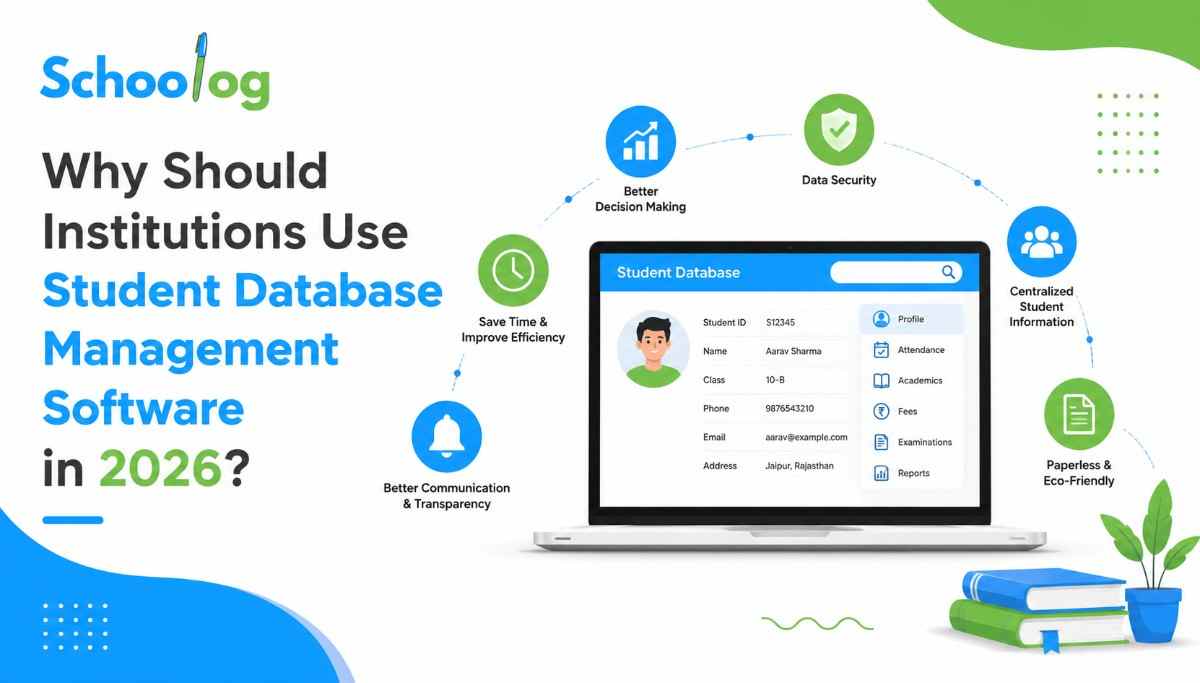
Why Should Institutions Use Student Database Management Software in 2026?
02 Sep, 2026
Students’ information is generated and collected by academic establishments every day. Institutions must maintain, manage, and process students’ personal information, admission records, attendance, marks, grades, fee payments, parent information, and documents. The management of information in schools and academic institutes poses some threats, such as a copy of records, current information, delay in administrative work, and unavailability of the required information when the institution requires it, but many schools are still using spreadsheets, paper files, and different kinds of software for different departments.
In 2026, the institution will require a systematic, secure, and interconnected system. Student Database Management software centralizes student data and makes it easier to manage records at different stages of the student life cycle.
What is Student Database Management Software?
Student Database software helps educational organizations collect, store, manage, and update all student-related information and other useful student records in a single database.
The following data could be stored by the software:
-
Admission and enrolment information
-
Parental details and guardian details
-
Attendance data and records
-
Exam results and academic records
-
Fee and payment details
-
Supporting documents and certificates
-
Transport and hostel details
-
Communication log and record
This information is spread across many files and systems; institutions can store it in a more organized student data structure.
1. Centralises Student Information
A prime benefit is centralization. Student records were spread across the various departments and thus managed in various ways. For example, the admission department managed enrollments, teaching staff managed examination results, while accounts looked after fee collection.
This creates data silos and makes data consistency a problem. A centralized student database brings all the relevant information in one place. Authorized personnel can pull out the required information without searching through the Excel sheets or asking to fetch records from other departments. This leads to developing one source of student data for all.
2. Reduce Manual Work and Errors
The manual input and maintenance of information is a time-consuming process and susceptible to an increased amount of mistakes. The duplication of student data across a range of spreadsheets and registers will lead to inconsistent, duplicated data and problems with different sections.
A student management system allows institutions not to carry out tasks for several days for administrative work by enabling them to store required data within the student database in digital format. If your institution has all the related information updated within records, then official access is available; it provides updated access to the recent information related to any department.
By doing so, your institution:
-
Decreases duplicate entries
-
Avoids manual mistakes
-
Saves on administrative time
-
Maintain data consistency
-
Less use of hard copy
Institutions have increased numbers of students and information flow, thus the necessity for automation.
3. Creates a Complete Student Profile
There are several departments a student will have dealings with at an educational establishment over their studies. Keeping all this information separate can make it challenging to develop a comprehensive student profile. The school database management software centralises vital student information.
|
Information Area |
Records that can be Managed |
|
Personal Details |
Contact and guardian information |
|
Academics |
Subjects, marks and performance |
|
Attendance |
Daily and historical attendance |
|
Finance |
Fees, payments and pending amounts |
|
Documents |
Forms, certificates and records |
|
Communication |
Notices and parent interactions |
Having all the student files centralized allows us to locate information more rapidly and thus make better decisions.
4. Increased data accuracy and uniformity
When student data is stored on more than one system, that leads to multiple different versions of the same data in different departments. For instance, a parent’s phone number may be updated in one database but not in another system they are in, causing disorganization and conflicts in communication. Streamlined and more accurate records in organizations using a central database and central systems in place have organized, more accurate records. You can update records in a systematic way, and a central record system works best when a lot of people rely on this data for communication, reporting, as well as a system for making decisions.
5. Provides Faster Access to Information
Many educational organisations require prompt access to their records. Whether the attendance data is wanted for the teaching staff, admissions for administration staff, or account status needed by the accounts department, locating this data within paper files and a string of spreadsheet files can be a time-consuming task.
Student databases can be used to search and retrieve necessary information rapidly by authorized staff. It removes administrative delay, and staff save time in finding files. It also increases cooperation between offices because they can search the data rapidly.
6. Strengths: Data Security and Access Control
Student information is confidential and should be carefully handled. Through role-based access, a modernized student database management system would enable institutions to manage which user should be able to view or edit which piece of information. Such as:
-
For teachers, the relevant student academic and attendance reports
-
For the accounts team, financial data management
-
For administrators, more depending on what they need to manage
-
For the parents, the relevant student data relating to their children
This kind of structure can assist the institution in limiting unnecessary user data access. In addition, a secure login with the ability to add permissions on each account of who sees what, log file recording, and backup support to a secure external location for all the records could further add to it.
7. Improves Communication with Parents and Students
A key aspect of student management is communication. If student data and communication are linked together, it makes it easier to send updates that apply to a certain set of students at the institution.
Schools can leverage information through them to relay information about:
-
Attendance updates
-
Payment reminders
-
Exam results
-
Important notifications
-
School activities and events
-
Student’s academics
Avoid wasting time seeking out contact lists every time you need to push out updates to a single centralized location.
8. Easy Decision Making and Reporting
School administrators use student data for several purposes to monitor student progress, campus usage, and school performance. Manually gathered from individual departments, it can be a time-consuming process to receive all necessary information. A student database management program will assist an institution in managing the information. Reports can be produced related to:
-
Attendance statistics
-
Results and academics
-
Fee collection status
-
Class strength report
-
Admission figures
The ability to retrieve the data in an organized manner allows the administrative personnel to analyze and make informed decisions rapidly. It is a far better approach than guesswork or manually put-together reports.
9. Supports the Complete Student Lifecycle
Management of a student information system should occur from the receipt of the enquiry or application throughout the entire journey of the student with the institution.
The lifecycle could encompass:
-
Enquiry
-
Admission
-
Enrollment
-
Attendance
-
Academics
-
Fees
-
Communication
-
Promotion
The management of these stages through unconnected systems is unnecessarily complicated. Student database software creates a stable structure for developing workflow, which would maintain progress during transitions. Institutions would maintain critical information in a readily accessible space and minimize information loss when switching between processes.
10. Helps Institutions Scale Efficiently
As an institution increases in size, so does the quantity of student data. A process that functions with just a few students can quickly become overwhelming in a larger enrollment or in an institution with more than one campus. Student database management software offers a scalable solution to growing information needs.
Rather than managing accounts efficiently. The significance of which becomes even greater in 2026, as schools and institutes are required to provide their services in a fast manner, maintain updated records, and provide a proper flow of communication to students.
How Schoollog Helps Manage Student Information
Schoollog helps institutions unify their school data and allows seamless integration of key school functions – admissions,attendance management system, academics, fees management system, and communication systems, all into a single user-friendly application. It breaks down data silos, promotes efficient workflow, and ensures students' data reaches relevant people at the right time.
Conclusion
With the academic year 2026 beginning, student records can appear scattered within documents, isolated applications, and a variety of spreadsheets. Software-based systems streamline student record management through information access automation and task simplification. Linked access to all student data within a central location can lead to an overall better experience for administrative staff, teachers, students, and their parents, as well as higher levels of workplace efficiency.
✍️ Muskan Singh
Hi, I'm Muskan Singh, a content writer passionate about exploring how technology, EdTech, and SaaS are shaping the...
Show More📞 Get In Touch
Have questions? We'd love to hear from you!
✍️ Muskan Singh
Hi, I'm Muskan Singh, a content writer passionate about exploring how technology, EdTech, and SaaS are shaping the...
Show More📞 Get In Touch
Have questions? We'd love to hear from you!
Related Blogs

What Is an Admission Management System for Schools?
Learn how an admission management system automates school admissions, simplifies form filling, reduces errors, and boosts efficiency for parents and staff.

Key Advantages of Admission Management System for Schools
Schools are the foundational institutions for individual growth and development. That is why Schools are increasingly adopting modern solutions to streamline various work and improve the educational experience. Among all school chores, one of the most important is managing the admission procedure. In the past, it was quite a complex procedure that required excessive documentation work and large manpower. But now with the advent of the Advanced Admission Management System(AMS), Schools can automate and centralise this difficult process easily by saving time, reducing errors, and improving communications. AMS is a comprehensive digital platform that automates and manages the end-to-end admission process from inquiry handling and online application to documentation verification, fee payments, and final enrollment, all done in a single platform, making the whole process convenient. But beyond mere convenience, the advantages of an Admission Management System are far-reaching. In this blog, we will delve into various benefits of the Admission Management System as it is one of the significant tools of today's world, which can enhance Operational efficiency.