

Blogs
📋 Table of Contents
Holistic Progress Card (HPC) for CBSE Schools
15 Jun, 2026
If you are still issuing traditional mark sheets as the sole statement of a student’s achievement, in a CBSE-affiliated school, know that you are no longer on the accepted path when it comes to assessment. The HPC for CBSE Schools is now the minimum expectation that the CBSE requires its schools to use- and understanding the operational implications of this expectation is the business of every principal, administrator, and teacher coordinator in India.
What is the Holistic Progress Card (HPC)?
The HPC is based not just on quantitative performance, but also provides a descriptive and analytical assessment. It covers not only academic accomplishments but also the growth of intellectual abilities in a child. Developed by the PARAKH assessment framework, the standards-setting body under NCERT, it is aligned with the NCFSE. It endeavors a learner-centered assessment.
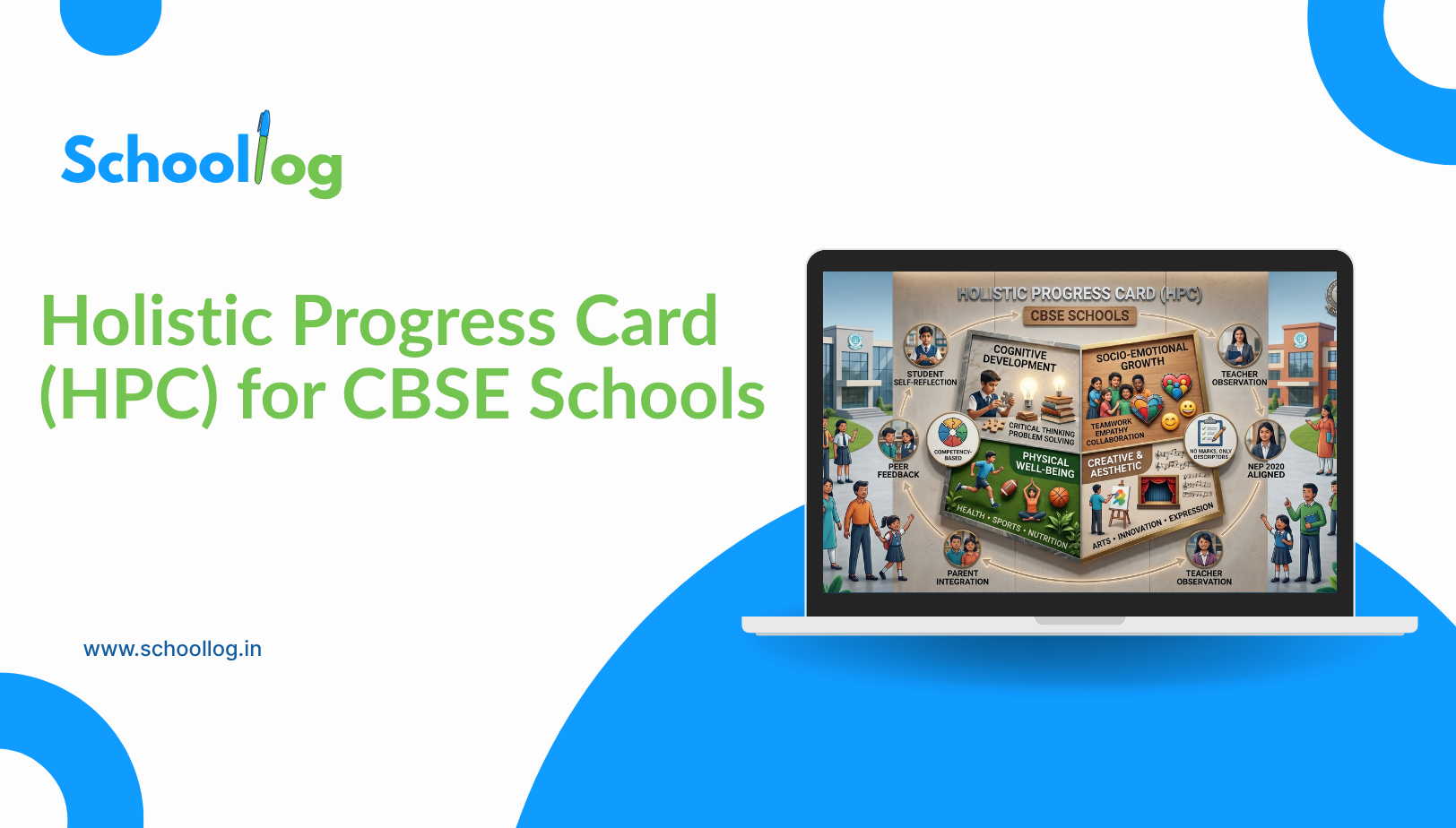
The Holistic Progress card is a 360 ° multi-dimensional card that encompasses the multifaceted and individualized learner by integrating cognitive, affective, socio-emotional, and psychomotor facets. It represents a paradigm shift from assessment towards evaluation as an ongoing formative and continuous process.
In other words, the HPC is not asking “what score did the student receive?” It is asking “how is this student growing as a learner, a team member, and an individual?”
What Does CBSE Mandate Under the HPC?
CBSE launched its own version of the implementation manual for the HPC model, starting at the Foundational Stage, up to class 2. The board accepted the HPC but with slight modifications where children from ages 3-6 are placed under a basic, developing, or proficient level. However, unlike the verbose NCERT HPC, the CBSE version uses simple flowers, trees, and smileys as neutral symbols that teachers can use to note down the children’s level.
From the academic year 2024-2025, all affiliated schools will mandatorily follow the HPC format as per the circular issued by the CBSE assessment system, along with guidelines, formats, and training for teachers.
The HPC assessment strategies consist of project work and inquiry-based learning, quizzes, role plays, group projects, a portfolio, as well as student self-assessment, peer assessment, and parent inputs, which is part of the HPC that can be termed as the HPC living document.
What Does the HPC Actually Evaluate?
The HPC assesses various aspects of a child's progress; it takes into consideration more than just his subject- wise marks. It is an appraisal of the child's ability regarding his relationship with others, creativity, and application of emotions at the classroom level.
It documents and shares academic and co-curricular progress, describes students' engagement with co-curricular activities, identifies the development of social-emotional characteristics, and provides students with individual feedback. With competency-based assessment, the emphasis moves toward skills development and the creation of a team involving teacher, parent, and child.
While the role of academics continues to hold relevance, evaluated through a competency-based education, with a curriculum implemented using a multidisciplinary approach, and students are made to think across disciplines, rather than in compartments.
To the school administration, the HPC is not simply an altered report card format. Instead, it represents a new approach to testing and, consequently, a new system for handling it.
Why This Matters for School Administration
The HPC represents a substantial burden on unprepared schools. Here’s how things look on the ground level:
-
Teacher Burden Increases:
Each teacher will have to manage an HPC for each student, document daily activities with photos, record students' work, and have the parents input regularly; all demanding time and consistency.
-
Parental Involvement formally occurs:
The process of teacher-led and parent-conferred (with student input) assessment takes place to make parents active stakeholders in learning, and not receivers of end-of-term report cards.
-
Data Collection must be Continuous:
This information needs to be gathered consistently. The HPC is a fact-based profile. This requires each area to be evidenced by an actual observation from the classroom routine.
In the absence of an adequate system, this leads to fragmented records, dropped documentation, and incomplete report cards.
How School Management Software Supports HPC Implementation
This is where technology comes into play. A school management system like Schoollog would also provide the CBSE school with a way to manage the HPC needs without overburdening administrative staff.
Teachers can log comments, add related activity evidence, and track performance trends throughout the entire term, not just during the reporting period, with the use of Schoollog’s school management software. Parent communications modules ensure that the school has formal feedback and update channels with parents, fulfilling a part of the participation requirement under HPC. The organized information is all available during the reporting period.
The shift of CBSE towards HPC signifies its resolve to introduce analytical, accountable, and objective practices in education, fitting into the broad principles of NEP 2020 assessment reforms for every child to experience teaching-learning that is measurable. Schools that reorient their administrative functions according to these principles will be best equipped, not just to fit into these changes, but to excel in terms of student development.
Frequently Asked Questions about the HPC for CBSE Schools
-
Is it mandatory for all the CBSE schools to use HPC?
Yes, it is compulsory for all the CBSE schools for the academic year 2024-2025, and these relevant guidelines as well as training material have been issued by CBSE.
-
What are the stages currently included in the HPC?
The HPC is presently mandatory at the foundational stage, ages 3 to class 2. The NCERT Holistic Progress Card has already been designed for all four stages of school education, which would likely be implemented.
-
What input from parents is expected?
The HPC includes feedback from parents as a part of the formal structure of the term. As parents are contributing members of their child’s education, instead of merely collecting end-of-term reports.
-
Can school software be used to maintain HPC documentation?
Yes, software solutions like Schoollog can give us the means to obtain, collate, and produce HPC reports easily. The workload will be reduced considerably for teachers, and CBSE compliance is ensured.
Conclusion:
The CBSE holistic progress card is not a quick remedy, but a road that CBSE and NEP 2020 are very clearly headed towards, an assessment beyond the rote-learning paradigm towards all-around development. The question before schools isn't whether to implement the HPC, but whether to implement it without exhausting it.
Schoollog provides CBSE schools with an easy transition from ongoing record keeping to engaging the parents and generating reports at the end of the term. If you have the system in place, your school progress card system will be able to get a record of what is really important in child development.
✍️ Muskan Singh
Hi, I'm Muskan Singh, a content writer passionate about exploring how technology, EdTech, and SaaS are shaping the...
Show More📞 Get In Touch
Have questions? We'd love to hear from you!
✍️ Muskan Singh
Hi, I'm Muskan Singh, a content writer passionate about exploring how technology, EdTech, and SaaS are shaping the...
Show More📞 Get In Touch
Have questions? We'd love to hear from you!
Related Blogs